Low scores in Indonesia’s school exams renew calls for education reform
The test, taken by final-year students at each level, measures proficiency in mathematics and Indonesian, with English and two elective subjects added for high schoolers. The results of the exams revealed persistently low performances.
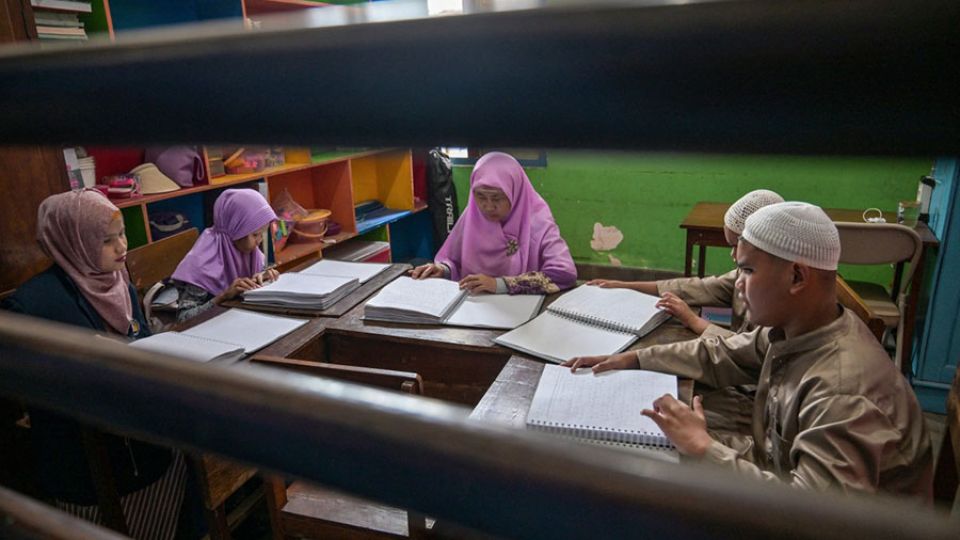
Low scores in elementary and junior high school exams have highlighted the need to improve Indonesia’s education system, with observers calling for reforms focused on teachers and school governance.
The Elementary and Secondary Education Ministry published the results of the first annual academic competency tests (TKA) for elementary and junior high school students on May 26, following the exam held in April. The first TKA test for senior high school students was held in October last year.
The test, taken by final-year students at each level, measures proficiency in mathematics and Indonesian, with English and two elective subjects added for high schoolers. The results of the exams revealed persistently low performances.
On a scale of 100, elementary school students scored an average 42 in math and 60 in Indonesian, while junior high students recorded 40 and 60, respectively. It mirrors those of 12th graders, whose average scores stood at 36 in math and 55 in Indonesian.
Education consultant Ina Liem noted that national exams like TKA, conducted under different names and schemes over the past two decades, had consistently shown poor literacy and numeracy performances.
The problem, she said, lies in an education system that should be reformed, particularly in school governance, which does not prioritize merit-based recruitment of principals and educators.
Ina also questioned the effectiveness of the TKA exams warning that an excessive focus on scores risks encouraging schools to prioritize test results over a meaningful learning process.
“I regret that we are returning to an era when learning is centered around examinations,” she said on Friday. “Education [benchmark] is being reduced, as if six years of elementary schooling can be measured solely through an exam taken over a few hours.”
The test provided only a limited picture of student development, she added, as it did not assess broader aspects such as communication skills, student characters and discipline.
Poor teaching
Education observer Jejen Musfah of Syarif Hidayatullah State Islamic University (UIN) Jakarta blamed the low scores, far below the minimum competency benchmark commonly set at 70, on students’ lack of preparedness, which he linked to inadequate teaching quality.
“The low scores reflect the government’s failure to provide the best teachers and learning facilities,” he said on Friday, emphasizing that “the quality of students ultimately reflects the quality of their teachers”.
Ubaid Matraji from education watchdog the Indonesian Education Monitoring Network (JPPI) said improving student competencies should begin with improving schools and teaching skills.
But he said that current education policies have sidelined those priorities particularly because the government used a portion of the constitutionally mandated education budget to fund the free nutritious meal program, which makes no direct contribution to education’s core function.
“If the government continues to focus on programs that do not tackle the underlying problems [in learning and teaching], there will be no meaningful improvement in the quality of our education,” he said on Friday.
Mapping skills
The schools ministry’s Elementary and Secondary Education Policy Agency (BKPDM) head Toni Toharudin said the TKA exam would generate a dataset to map students’ competencies and help policymakers formulate precise education policies based on students’ actual needs.
He said the test was not intended to label students, schools or regions, although the low scores pointed to weaknesses in students’ reasoning and problem solving abilities.
“This is our shared concern that logical thinking, mathematical reasoning and problem solving skills need to be continuously strengthened in daily learning,” Toni said in a statement last week.
Schools minister Abdul Mu’ti has previously said the TKA was not a requirement for graduation and was voluntary to avoid burdening students. Observers, however, argue that the test still creates pressure since the scores can be used as one of the criteria for admission to higher levels of education.
The ministry now seeks to make the test easier following complaints from high schoolers. For the upcoming test scheduled for October, the ministry will extend the test duration, reduce the number of math questions and spread the five subjects over four days of exam instead of two.




-
JPPI Ingatkan Pemerintah Pendidikan Gratis Harus Cakup Sekolah Swasta
Jaringan Pemantau Pendidikan Indonesia (JPPI) menyoroti pemerintah yang belum melaksanakan putusan Mahkamah ... -
-
-
-