One year on, pressure builds on Indonesian government to enforce free education ruling
The court found that Article 34 of the Sisdiknas Law, which mandates free basic education for all, had been interpreted too narrowly by applying only to state schools.
Education watchdogs are pressing the government to immediately enforce a Constitutional Court ruling mandating free basic education at both public and private schools, a year after the decision was issued with no concrete follow-up from the state.
The ruling, issued on May 27, 2025, through a judicial review of the 2003 National Education System (Sisdiknas) Law, ordered the government to guarantee free compulsory education at elementary and junior high school levels, including equivalent madrasah (Islamic schools), to ensure equal access to education.
The court found that Article 34 of the Sisdiknas Law, which mandates free basic education for all, had been interpreted too narrowly by applying only to state schools.
At the same time, the court acknowledged that some private schools offered additional curricula or international programs as their distinguishing feature. Since parents enrolling their children in such schools were generally aware of the higher costs involved, the court ruled that these institutions could be exempt from the free education policy.
The policy was expected to take effect immediately after the ruling was issued.
However, the Indonesian Education Monitoring Network (JPPI), which filed the petition, said the government had yet to take any meaningful steps toward implementing the ruling, particularly by failing to issue a presidential regulation as the legal basis for nationwide enforcement.
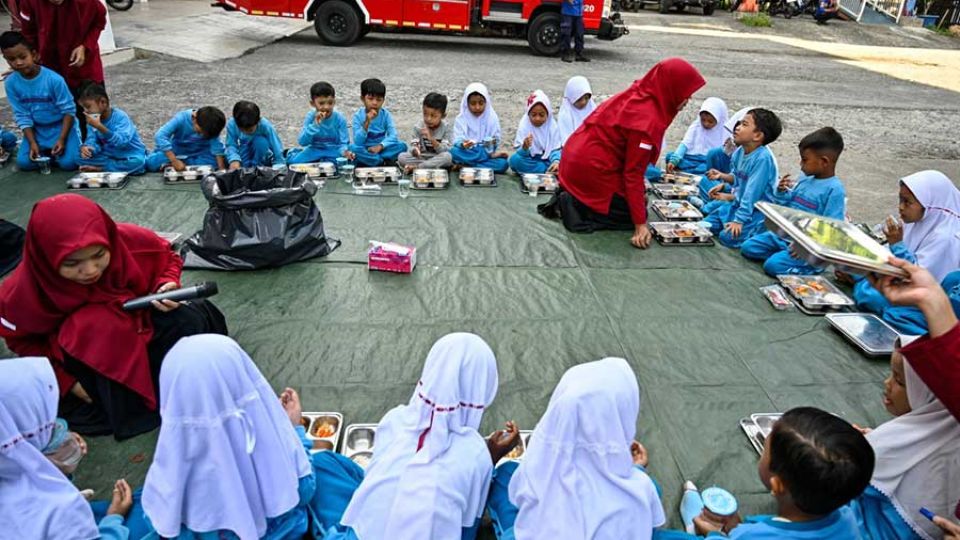
JPPI national coordinator Ubaid Matraji argued that financing free basic education was feasible given Indonesia’s Rp 769 trillion (US$43.2 billion) education budget. However, he said the government appeared to prioritize other presidential flagship programs instead, including the free nutritious meal program, which has absorbed around 30 percent of the education budget.
“There is actually no technical obstacle [to implementing the policy]. The problem is the government’s unwillingness to allocate funds for free basic education,” Ubaid said in a discussion in Jakarta on Monday.
A teacher counts the number of meal packages disbursed under the free nutritious meal program before being distributed to students at Islamic elementary and junior high schools in Aceh Barat regency, Aceh on May 20, 2025. (Antara/Syifa Yulinnas)
Education expert Darmaningtyas, who attended the discussion, noted that some private schools catered to upper-income families by offering international curricula or foreign-language programs, meaning they did not necessarily require government assistance.
Still, he argued that many children ended up in private schools after failing to secure places at free state schools, leaving low-income families vulnerable to high tuition fees and the risk of dropping out.
Ubaid revealed that around 3.9 million children in Indonesia remained out of school as of May. Around 70 percent of them, he added, had dropped out after being unable to afford private school fees when they failed to gain admission to state schools.
He urged the government to immediately implement the Constitutional Court ruling, warning that “we risk losing Indonesia’s golden generation at the basic education level.”
The Elementary and Secondary Education Ministry did not immediately respond to The Jakarta Post’s requests for comment.




-
Persoalan Kaus Kaki Berujung Dugaan Penganiayaan Kepala MI di Lamongan, JPPI Bersuara
Dugaan penganiayaan terhadap Kepala Madrasah Ibtidaiyah (MI) di Desa Meluntur, Kecamatan Glagah, ... -
-
-
-